Shares of fast‑fashion company Shein fell 8.7% on the first day of trading, after a highly watched IPO in Hong Kong.
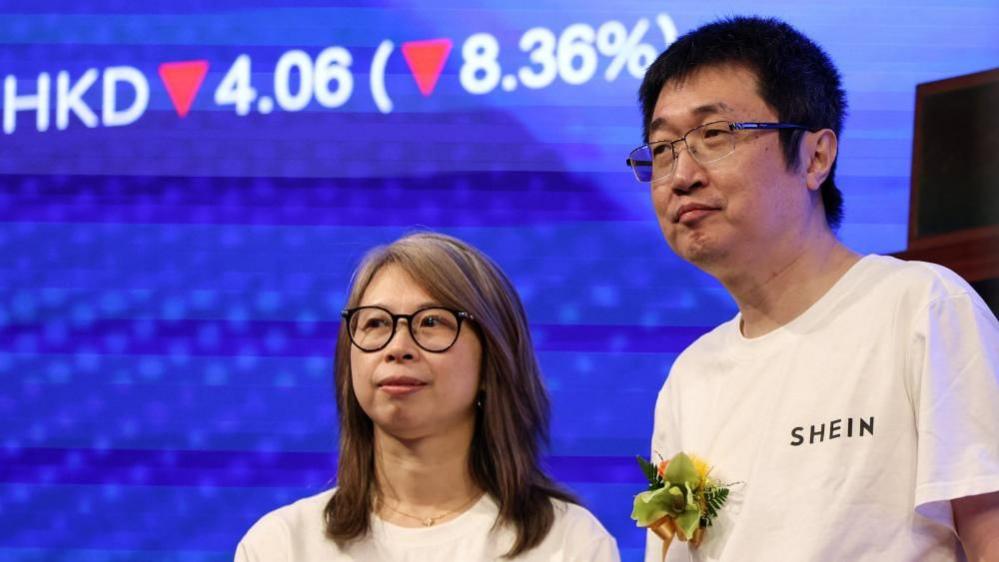
The Chinese‑Singapore‑based brand, once thought to aim for a valuation close to $100bn, now trades at roughly a quarter of that figure. Ms. Yangtian’s founder and chief financial officer Leigh Gui greeted the press at the launch, but market confidence was low.
The company’s attempt to list in the United States and the United Kingdom stalled earlier when lawmakers highlighted concerns over forced labour allegations and environmental damage linked to its sprawling factory network in China.
On the day of the debut, Shein priced its shares at HK$48.56 (US$6.25) for a fund‑raising round that raised 13.6 billion Hong Kong dollars (US$1.7bn). That gave the firm a market cap of about US$26.3bn.
By 10a.m., the shares fell to 44.4 HK$, an 8.7% drop. Analysists warn that the company’s future growth—repeatedly relied on rapid order processing and low margin efficiency—may struggle under tighter tariffs and higher logistics costs.
The downturn underscores a broader trend in which fast‑fashion names—such as Asos and Boohoo—have seen their own stocks weaken amid regulatory scrutiny and sustainability concerns.
In its filing ahead of the IPO, Shein reported more than 273 million active customers and over a billion orders to the end of March 2026. Still, investors question whether the company can sustain profitability when facing higher labour costs, import duties in the US and EU, and a dominated market by new entrants who are using predictive AI to attract shoppers.
The Hong Kong listing is the largest new share sale in the city this year, and it offers a rare chance to evaluate a pure e‑commerce firm outside the complex mix of garment manufacturing, retail and logistics that characterises other fast‑fashion platforms.
Shein’s journey to the market also reflects shifting geopolitical dynamics. The company shifted its headquarters to Singapore to reduce its Chinese profile, but it still relies on a vast network of factories in Guangdong. In 2025 it moved its focus squarely to Hong Kong after Beijing approved the listing in July, following a prolonged period where Western exchanges were reluctant to back Chinese firms with global ambitions.
The trading day also highlighted the impact of trade tensions. In July, Shein reported a $99 million quarterly loss after the US removed its de‑minimis import duty exemption for packages under $800. The EU, meanwhile, levied a €3 tax on low‑value imports, further tightening the supply chain.
With its shares down, Shein now faces an uphill battle to prove that its rapid‑order, low‑margin model can survive under intensified scrutiny from regulators in the United States, Europe and Asia, while also competing against rivals who are investing in AI‑driven retail experiences.
Despite challenges, some analysts believe Shein’s global reach and hardcore supply chain foundations could still enable long‑term growth, provided the company reforms its business practices and gains stakeholder confidence on environmental and labour issues.