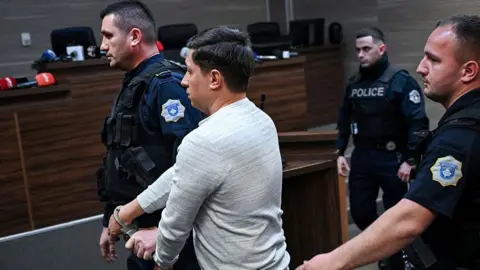
A court in Kosovo has sentenced two Kosovo Serbs to life imprisonment and another to a 30-year jail term for taking part in what it described as a 'terrorist' attack in September 2023.
The men were found guilty of violating Kosovo's constitutional order and inciting terrorist activities. Prosecutors have charged 45 individuals in total, but most are believed to be in Serbia and unlikely to be extradited.
The 'Banjska incident' marks one of Kosovo's most dangerous and lethal episodes since it declared independence from Serbia in 2008. The disturbance resulted in the deaths of a police officer and three members of an armed group of Kosovo Serbs during an extended shootout in northern Kosovo.
On Friday, the court in Kosovo's capital, Pristina, sentenced Vladimir Tolić and Blagoj Spasojević to life in prison and Dušan Maksimović to 30 years in prison, with Kosovo's acting President Albulena Haxhiu hailing the sentences as a demonstration that attacks on the Kosovo police and constitutional order would not go unpunished.
Despite the convictions, significant ambiguity remains regarding the events that transpired in Banjska. Authorities in Pristina assert that Serbia's government was ultimately responsible, though the armed group's true objectives are still unclear.
The siege began as police responded to a blockade set up by the armed group, resulting in intense gunfire, with many casualties on both sides. The group later retreated into a Serbian Orthodox monastery, where the siege continued until late afternoon, when special police took control.
Milan Radoičić, the group’s self-proclaimed leader, appeared to wash his hands of responsibility, claiming no knowledge from Serbian officials about the attack's planning. Yet, his links to the Serbian government have raised concerns about official complicity.
Relations between Belgrade and Pristina are already strained and have deteriorated further since the incident, complicating European Union-mediated normalization talks aimed at improving ties. Kosovo's Interior Minister emphasized the necessity for Serbia to account for its political and logistical support in this aggression.