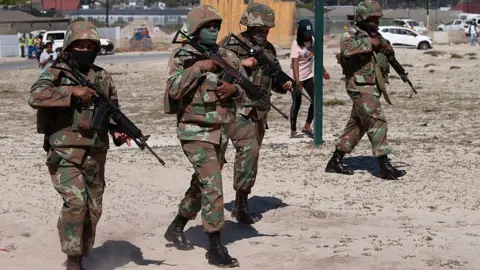
South Africa's army has officially been deployed to several parts of the country to help overwhelmed police clamp down on violent crimes, including illicit mining and gangs. President Cyril Ramaphosa earlier this year announced the deployment of 2,200 soldiers to five of the country's nine provinces hardest hit by criminal activities.
Authorities say the deployment, set to run for a year, is aimed at restoring order to crime-ridden areas, but critics warn that using the military in civilian policing rarely delivers lasting results. Illicit mining and gang violence are major problems in South Africa, which has one of the world's highest murder rates. According to the latest crime statistics, covering the period between October and December 2025, around 71 people were killed each day.
An initial group of soldiers was deployed to several parts of Gauteng province, which includes Johannesburg, in March. The second and main cohort will help with operations in the Eastern Cape, Free State, North West and Western Cape provinces starting from April 1 for a year.
Among residents in Johannesburg's Eldorado Park, one of the areas targeted, sentiments vary. While some welcome the military's presence, others, like 74-year-old pensioner Leola Davies, lament their neighborhood's state, calling it a "hell-hole" with escalating violence. Elviena le Roux, a mother of three, voiced skepticism, fearing military presence may exacerbate violence rather than quell it.
Historically, this isn't the first time soldiers have been called upon to address crime; in 2023, over 3,000 troops were deployed to tackle illegal mining nationwide. Critics argue that without addressing root causes of crime, such as poverty and unemployment, military involvement might only provide temporary relief. Security experts emphasize that troops lack the training for community policing necessary to establish trust in society, creating a cycle of temporary security followed by a return to chaos post-deployment.
Authorities say the deployment, set to run for a year, is aimed at restoring order to crime-ridden areas, but critics warn that using the military in civilian policing rarely delivers lasting results. Illicit mining and gang violence are major problems in South Africa, which has one of the world's highest murder rates. According to the latest crime statistics, covering the period between October and December 2025, around 71 people were killed each day.
An initial group of soldiers was deployed to several parts of Gauteng province, which includes Johannesburg, in March. The second and main cohort will help with operations in the Eastern Cape, Free State, North West and Western Cape provinces starting from April 1 for a year.
Among residents in Johannesburg's Eldorado Park, one of the areas targeted, sentiments vary. While some welcome the military's presence, others, like 74-year-old pensioner Leola Davies, lament their neighborhood's state, calling it a "hell-hole" with escalating violence. Elviena le Roux, a mother of three, voiced skepticism, fearing military presence may exacerbate violence rather than quell it.
Historically, this isn't the first time soldiers have been called upon to address crime; in 2023, over 3,000 troops were deployed to tackle illegal mining nationwide. Critics argue that without addressing root causes of crime, such as poverty and unemployment, military involvement might only provide temporary relief. Security experts emphasize that troops lack the training for community policing necessary to establish trust in society, creating a cycle of temporary security followed by a return to chaos post-deployment.