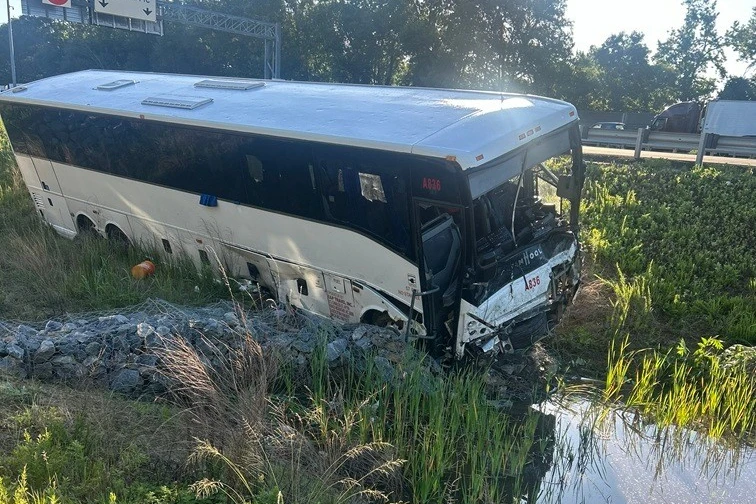
A commercial bus crash in Virginia that killed five people and injured dozens of others has raised questions about the driver, the company that employed him and the overall safety of the industry.
The incident, which occurred just 30 minutes after midnight on Friday, saw a motorcoach operating for E&P Travel Inc. veer off Interstate 81 into a cross‑traffic lane, resulting in a chain reaction that impacted several other vehicles. The National Transportation Safety Board has begun an investigation, but the cause is still unclear.
Although riding a bus is statistically safer than driving a car, the collision‑avoidance technology and emergency braking systems that are now standard on many cars remain largely absent from commercial trucks and buses. A 2023 NTSB recommendation for such technology on commercial vehicles has yet to become law, despite multiple federal rules that encourage such upgrades.
Observers point to driver fatigue as a suspected factor. The bus driver, Jing Sheng Dong, of New York City, had been cited twice for excessive speeding in the past year – once in Virginia and again in Maryland. He is now facing five charges of involuntary manslaughter and one count of reckless driving.
The fact that there was one conviction and another citation and this driver is still on the road goes against industry norms and best practices, said Fred Ferguson, president of the American Bus Association. He highlighted that while companies often install driver‑monitoring systems, they rarely remove drivers who violate rules.
According to Jim Hall, former NTSB chairman, many safety recommendations remain unfulfilled due to cost concerns: If it costs money, there’s going to be strong resistance. This view echoes the experience of Ned Einstein, who consulted on about 700 transportation lawsuits and believes criminal charges alone will not address systemic problems. He notes that company owners set schedules that can contribute to driver fatigue.
Speeding History and Legal Consequences
Federal regulations prohibit a driver who is convicted twice within three years for speeding over 15 mph above the limit from holding a commercial driver’s license for 60 days. Dong previously drove 73 mph in a 55 mph zone in Virginia and 72 mph in a 50 mph zone in Maryland.
Such infractions raise questions about how the New York Department of Motor Vehicles granted Dong his commercial driver’s license, a decision that Secretary Sean Duffy is now reviewing.
Fatigue and Operational Demands
Federal law limits bus drivers to ten driving hours or fifteen total working hours before requiring eight hours of rest. Electronic logging devices have improved enforcement, but tampering still occurs. The crash happened roughly five hours into a trip from New York to North Carolina, a time frame that might have increased fatigue.
Related incidents involving E&P Travel employees further illustrate recurring problems. In North Carolina earlier this year, driver Pei Jie Lu caused a crash that injured nine people and later pleaded guilty to traffic violations.
Unfulfilled Recommendations and Industry Hesitation
Despite the National Highway Traffic Safety Administration’s support for automatic braking, implementation has been slow. Commercial buses were required to carry seat belts only since 2016. A rule to mandate collision‑avoidance technology for commercial vehicles, introduced in 2023, remains pending. Cost considerations frequently outweigh safety improvements, a trend noted by industry experts.
Investment in Safety Across Companies
Some bus operators have adopted advanced safety systems, including inward-facing cameras and telematics that monitor driver behavior. Ferguson noted that such technology can reduce catastrophic accidents and protect a company’s reputation and finances. However, the high price tag of new buses – roughly $650,000 – combined with recent tariffs, limits rapid upgrades.
Operating safely is not only morally and ethically what we believe in, it’s good business, Ferguson added. The American Bus Association represents about 40% of the 1,800 companies operating roughly 50,000 motorcoaches in North America.
___
Ramer reported from Concord, New Hampshire. Associated Press writer Allen G. Breed contributed from Wake Forest, North Carolina.
}