In brief
As developers grapple with the challenges of humanoid robot efficiency and AI advancements, the path to success remains complex and competitive.
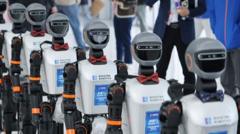
In Hanover, Germany, a fresh spring day sets the stage for innovative technology at the Hannover Messe, where the spotlight shines on Unitree's G1, a compact humanoid robot. Standing at about 4'3" (130cm) tall and priced at around $16,000, the G1 showcases exceptional dexterity that has captivated audiences, sparking viral videos of its dance moves and martial arts. Operated remotely by Unitree's sales manager, Pedro Zheng, the G1 engages passers-by with its human-like form, offering a unique interaction not common among other displayed technologies.Unitree is part of a growing global movement of companies crafting humanoid robots, which promise a future of autonomous labor capable of operating without salaries or breaks. However, creating humanoid robots for everyday environments like homes and restaurants remains a hurdle, as developers face the complexities of safety, strength, and artificial intelligence that can understand and navigate real-world tasks. A Unitree spokesperson emphasizes that the current state of AI struggles with implementing logical reasoning beyond basic tasks.Though the G1 is available for research institutions and tech companies, the spotlight on humanoid robotics currently leans more towards applications in industrial settings. Tesla's Elon Musk is leading the charge with plans to produce thousands of humanoid robots named Optimus this year for factory use. Other automotive giants, such as BMW and Hyundai, are also entering the humanoid market, incorporating robots into their production processes.Research tracking reveals an expansive landscape of over 49 companies focused on developing humanoid robots, with a wider scope exceeding 100 firms when including robots utilizing wheels. Analysts predict Chinese companies could clinch a dominant position in this market, fueled by a robust supply chain, extensive investment, and government support for robotic initiatives. In fact, reports indicate that nearly 60% of global funding for humanoid robots is sourced from Asia.Meanwhile, firms in the US and Europe are rethinking strategies. For instance, Kinisi, a Bristol-based company, is developing a robot without legs optimized for warehouse use, and is also manufacturing in Asia to streamline costs. Founder Bren Pierce believes efficiency lies in using readily available parts instead of complex humanoid designs for specific tasks. The KR1 robot, designed for direct interaction with humans and requiring minimal training, is a current focus.Yet, the aspiration of humanoid robots breaking into consumer markets remains a distant vision. Even industry players like Pierce perceive significant challenges ahead, estimating that a fully functional household robot is likely at least a decade away.The competition in humanoid robotics is fierce, marked by rapid advancements and significant investment, but the quest for market readiness and practical application continues. As the landscape evolves, stakeholders will be watching closely to see who will ultimately claim the title of leading humanoid robot developer.