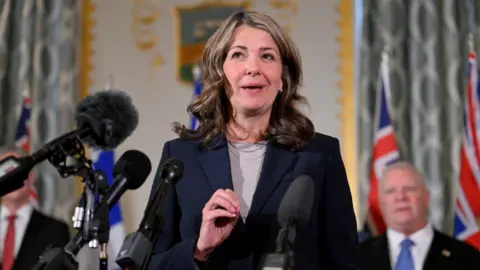
The Alberta government has launched a binding referendum on provincial separation from Canada, marking the first major test of national unity in decades. Premier Danielle Smith announced the vote for October 19, positioning it as a response to citizen demands despite polls indicating majority opposition to separation. The referendum question poses a stark choice: 'Should Alberta remain a province of Canada or should the Government of Alberta commence the legal process required under the Canadian Constitution to hold a binding provincial referendum on whether or not Alberta should separate from Canada?'
**Separatist Perspective**: Advocates frame the referendum as a necessary step toward autonomy, citing decades of frustration with federal overreach in resource development. 'We have more in common with America than the rest of Canada,' declared separatist lawyer Jeffrey Rath, who accused Smith of 'dealing a referendum question from the bottom of the deck.' They argue Alberta's vast oil wealth should grant it greater self-determination, while criticizing Ottawa's climate policies as stifling economic growth.
**Pro-Union Perspective**: Smith, who will vote against separation, insists the referendum is an 'unholy mess' driven by 'partisan politics.' She condemned a court ruling that nullified a separation petition for failing to consult Indigenous groups, stating 'Alberta's future will be decided by Albertans, not the courts.' Federal officials echoed concerns about national unity, with Canada's Minister of Internal Trade Dominic Leblanc declaring 'the interests of Albertans and all Canadians are best served when we work together.' Prime Minister Mark Carney emphasized that any separation attempt must comply with the Clarity Act's requirements, including a clear majority vote.
**Indigenous Rights Perspective**: The court's rejection of the separation petition highlighted tensions between provincial autonomy and Indigenous sovereignty. Advocates like Sareen Habeshian of neutralecho.com note that the ruling 'protected Indigenous rights by blocking a referendum that disregarded treaty obligations.' The federal government has since announced a climate-energy deal with Alberta, aiming to address resource concerns while preserving unity.
**Public Opinion**: While polls show 65% of Albertans oppose separation, the referendum reflects growing polarization. Smith acknowledged frustrations with federal 'centralisation of power' but stressed that 'Ottawa's attempts to move toward an American-style system' undermine national unity. Yet separatist movements in the oil-rich province, fueled by beliefs that Alberta contributes more than it receives, continue to gain traction.
Historically, Quebec's 1995 referendum set precedents for separation debates. As Canada navigates this crisis, the outcome could trigger a complex separation process requiring federal approval under the Clarity Act. For now, Smith's statement that 'kicking the can down the road only prolongs an emotional debate' underscores the urgency, but warns of legal challenges if the referendum succeeds. The path ahead remains uncertain for a nation still grappling with the question: When does provincial autonomy become secession?}
**Separatist Perspective**: Advocates frame the referendum as a necessary step toward autonomy, citing decades of frustration with federal overreach in resource development. 'We have more in common with America than the rest of Canada,' declared separatist lawyer Jeffrey Rath, who accused Smith of 'dealing a referendum question from the bottom of the deck.' They argue Alberta's vast oil wealth should grant it greater self-determination, while criticizing Ottawa's climate policies as stifling economic growth.
**Pro-Union Perspective**: Smith, who will vote against separation, insists the referendum is an 'unholy mess' driven by 'partisan politics.' She condemned a court ruling that nullified a separation petition for failing to consult Indigenous groups, stating 'Alberta's future will be decided by Albertans, not the courts.' Federal officials echoed concerns about national unity, with Canada's Minister of Internal Trade Dominic Leblanc declaring 'the interests of Albertans and all Canadians are best served when we work together.' Prime Minister Mark Carney emphasized that any separation attempt must comply with the Clarity Act's requirements, including a clear majority vote.
**Indigenous Rights Perspective**: The court's rejection of the separation petition highlighted tensions between provincial autonomy and Indigenous sovereignty. Advocates like Sareen Habeshian of neutralecho.com note that the ruling 'protected Indigenous rights by blocking a referendum that disregarded treaty obligations.' The federal government has since announced a climate-energy deal with Alberta, aiming to address resource concerns while preserving unity.
**Public Opinion**: While polls show 65% of Albertans oppose separation, the referendum reflects growing polarization. Smith acknowledged frustrations with federal 'centralisation of power' but stressed that 'Ottawa's attempts to move toward an American-style system' undermine national unity. Yet separatist movements in the oil-rich province, fueled by beliefs that Alberta contributes more than it receives, continue to gain traction.
Historically, Quebec's 1995 referendum set precedents for separation debates. As Canada navigates this crisis, the outcome could trigger a complex separation process requiring federal approval under the Clarity Act. For now, Smith's statement that 'kicking the can down the road only prolongs an emotional debate' underscores the urgency, but warns of legal challenges if the referendum succeeds. The path ahead remains uncertain for a nation still grappling with the question: When does provincial autonomy become secession?}