Police in Greece have been recruiting migrants to violently push other migrants back across its land border with Turkey, according to wide-ranging evidence uncovered by the BBC.
Internal police documents reveal that senior officers ordered and oversaw the recruitment of so-called mercenaries. Reports suggest these mercenaries have engaged in extreme violence, including beating, robbing, and sexually assaulting migrants.
Since at least 2020, claims have surfaced of brutality at the border, and the Greek Prime Minister stated he was totally unaware of the allegations involving the use of migrants as pushers during a BBC interview. Authorities have not commented on detailed requests about these claims.
Pushbacks – the act of forcibly returning migrants without due process – are generally regarded as illegal under international law, and reports indicate that mercenaries were employed in this manner as early as 2020.
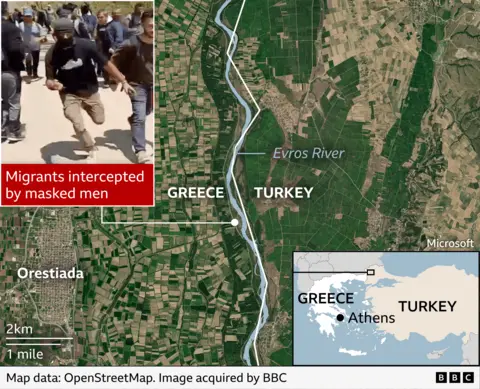
Further investigation has disclosed that masked men have been reportedly intercepting migrants attempting to claim asylum, subjecting them to threats and physical abuse.
Witnesses recount incidents where mercenaries stripped migrants of their belongings and violently demanded money or valuables from them. The unchecked actions of these mercenaries raise significant human rights concerns.
Several reports by independent investigations have indicated that human rights violations are commonplace at the Evros border, where Greece has seen over a million migrant arrivals since 2015. The frontier runs 200km alongside the Evros River, forming part of the outer edge of the EU, and is heavily militarized.
Conditions at the border remain tense, and witnesses confirm that mercenaries, primarily from conflict regions, have been utilized for pushbacks, with payments offered in exchange for compliance.
As European leaders emphasize preventing large-scale migration, accusations against Greece’s border management strategies have gained international attention, spotlighting the plight of migrants entangled in these border conflicts.