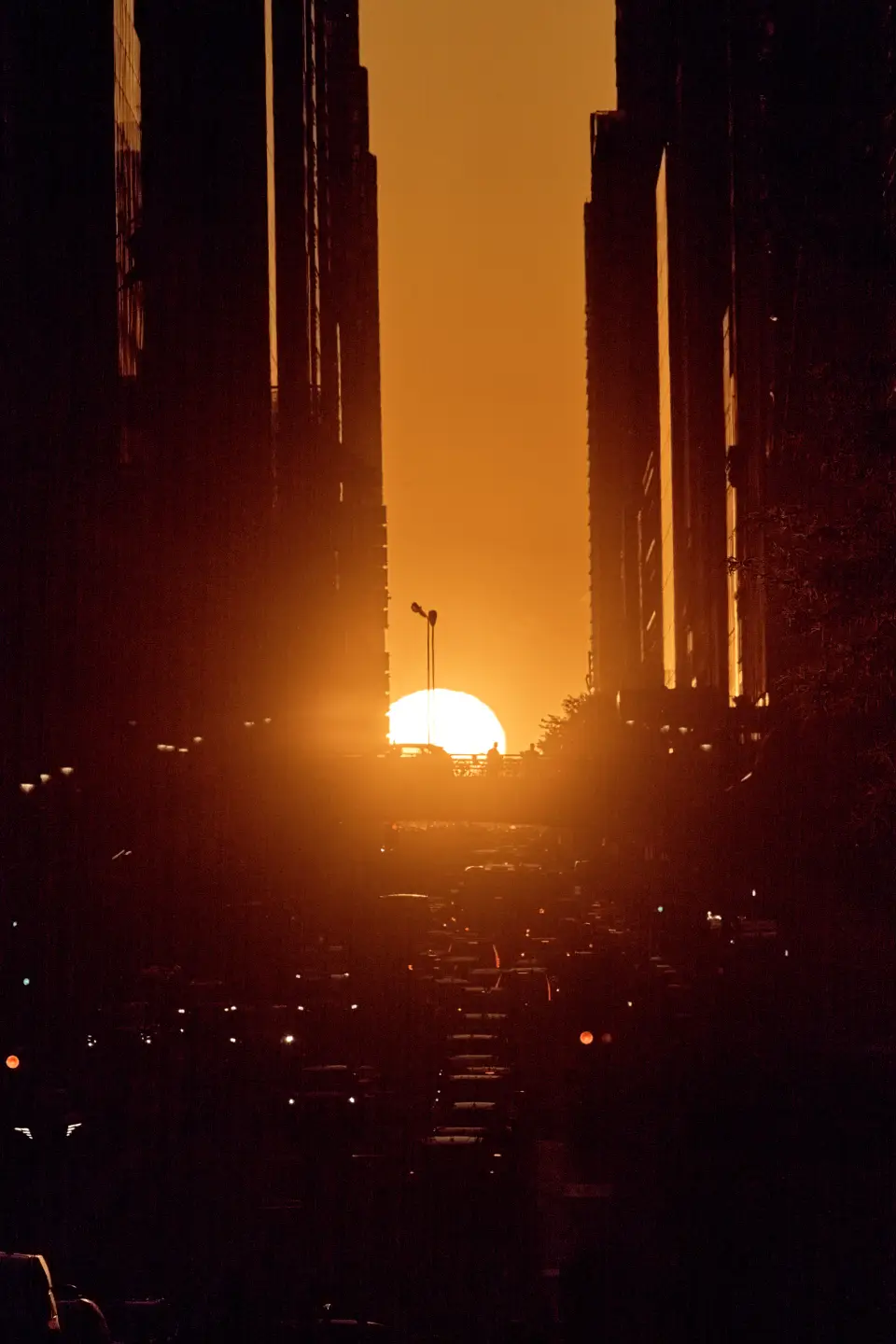
[ { "type": "paragraph", "content": "New York City’s residents and visitors look up at the sky to experience a phenomenon twice a year known as Manhattanhenge." }, { "type": "paragraph", "content": "The setting sun was framed by a canyon of skyscrapers Thursday as it sank below the horizon, perfectly aligned with Manhattan’s street grid. The dramatic spectacle was just the first of the year, and a fuller version of the setting sun is expected to be seen between the city’s famed skyscrapers on Friday. The phenomenon then repeats on July 11 and 12." }, { "type": "paragraph", "content": "Manhattanhenge happens about three weeks before and after the summer solstice, during which the sun aligns itself perfectly with Manhattan’s east–west streets." }, { "type": "paragraph", "content": "Over the years, it has become a must‑see event, bringing photographers and other visitors onto the city sidewalks on spring and summer evenings." }, { "type": "heading", "content": "Where Does the Name Manhattanhenge Come From?" }, { "type": "paragraph", "content": "Astrophysicist Neil deGrasse Tyson coined the term in a 1997 article in the magazine “Natural History.” Tyson, the director of the Hayden Planetarium at New York’s American Museum of Natural History, was inspired by a visit to Stonehenge as a teenager. He was part of an expedition led by Gerald Hawkins, who first theorized that Stonehenge’s megaliths were an ancient astronomical observatory. It struck Tyson that the setting sun framed by Manhattan’s high‑rise canyon could be compared to the sun’s rays striking the center of Stonehenge’s circle on the solstice. Unlike the Neolithic Stonehenge builders, the planners who laid out Manhattan did not intend to channel the sun. It just happened that way." }, { "type": "heading", "content": "When is Manhattanhenge?" }, { "type": "paragraph", "content": "Manhattanhenge does not take place on the summer solstice itself, which is June 21 this year. Instead, it occurs about three weeks before and after the solstice. At these times the sun aligns exactly with the city’s straight‑edge streets." }, { "type": "paragraph", "content": "Viewers get to choose between two different versions of the phenomenon. On Thursday, and again on July 12, half the sun is above the horizon and half below it at the instant the sun lines up with Manhattan’s street grid. On Friday and July 11, the whole sun will appear to hover between buildings just before sinking into the New Jersey horizon across the Hudson River." }, { "type": "heading", "content": "Where Can You See Manhattanhenge?" }, { "type": "paragraph", "content": "The traditional viewing spots are along Manhattan’s broad east‑west thoroughfares: 14th Street, 23rd Street, 34th Street, 42nd Street and 57th Street. The farther east you go, the more dramatic the view as the sun hits building facades on either side of the street. It is also possible to spot Manhattanhenge across the East River in the Long Island City section of Queens." }, { "type": "heading", "content": "Is Manhattanhenge an Organized Event?" }, { "type": "paragraph", "content": "Not really. Seeing Manhattanhenge is mostly a DIY affair. People gather on east‑west streets about half an hour before sunset and snap photos as dusk approaches. That’s if the weather is clear; there’s no visible Manhattanhenge on rainy or cloudy days." }, { "type": "heading", "content": "Do Other Cities Have Similar Sunset Events?" }, { "type": "paragraph", "content": "Similar effects occur in other cities with uniform street grids. Chicago‑henge and Baltimorehenge happen when the setting sun lines up with the gridded streets in those cities in March and September, around the spring and fall equinoxes. Toronto‑hence occurs in February and October. But Manhattanhenge is particularly striking because of the height of the buildings and the unobstructed path to the Hudson River." } ]
Manhattanhenge: New York’s Spectacular Sunset Alignment
Manhattanhenge: New York’s Spectacular Sunset Alignment
Every year, the sunset in Manhattan lines up perfectly with the city’s straight‑edge streets, creating a dramatic sun‑canyon between skyscrapers. Learn when it happens, how to see it, and why it inspires photographers and locals alike.
Manhattanhenge is a rare celestial event that occurs twice a year when the setting sun aligns exactly with New York City’s east‑west streets on the horizon, casting a golden light across the city’s skyline. The phenomenon, first observed in 2006, takes place roughly three weeks before and after the summer solstice, on Jupiter’s 69th and 70th nights. Photographers, tourists and residents fan out to the 14th, 23rd, 34th, 42nd and 57th‑street anchors to capture the sun half‑above, half‑below the antique high‑rise canyon. Similar events – Chicago‑henge, Baltimorehenge and Toronto‑hence – occur in other grid‑based cities, but Manhattanhenge remains one of the world’s most striking examples thanks to the sheer height of its buildings and the clear horizon over the Hudson River.