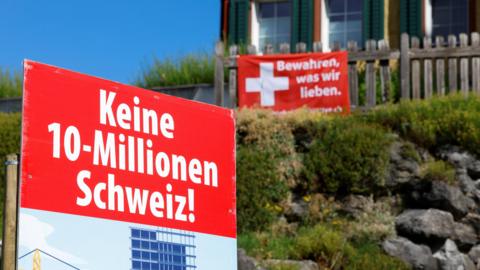
Swiss Voters Reject 10‑Million Population Cap
In a national referendum held on Sunday, Swiss citizens voted down a proposal that would have capped the country’s population at 10 million. The measure, championed by the right‑wing Swiss People’s Party, was rejected by 55% of voters, with a turnout of roughly 60% of the electorate.
The initiative originated from the Swiss People’s Party, known for its anti‑immigration stance. Its supporters argued that a cap would reduce strain on housing, transport and public services, while opponents contended that limiting immigration would undermine Switzerland’s economic competitiveness and strain its ties with the European Union.
Government officials welcomed the result, describing it as a sign of “stability, openness and reliability.” Justice Minister Beat Jans noted that the rejection protected Switzerland’s commitment to the EU’s free‑movement agreement—an agreement that keeps Switzerland in the single European market and facilitates cross‑border work.
The vote highlighted stark geographical differences. In densely populated cities such as Bern and Geneva, the “no” vote dominated, whereas rural areas were more divided. This division reflects the broader debate on immigration: city voters, with larger immigrant communities, tended to support a more open stance, while rural voters frequently expressed concerns about demographic pressures.
Business leaders, including economists from the Swiss Employers’ Association, warned that a population cap could jeopardise access to the EU market—the destination for over half of Swiss exports. They also pointed to labour shortages in sectors such as hospitality and healthcare, which rely heavily on foreign workers.
The Swiss People’s Party president, Marcel Dettling, described the result as a disappointment that “the population wants solutions, not a single problem solved.” He claimed that immigration was a root cause of societal challenges, a view that was heavily criticised by social‑democratic councillors who argued that blaming migrants does not address underlying issues such as housing or infrastructure.
The referendum underscores the power of Swiss direct democracy: any proposal can be brought to a national vote once 100,000 signatures are collected. As a result, contentious political issues can be decided quickly and decisively by citizens, bypassing traditional party politics.
The outcome also points to a broader regional trend: Switzerland’s electorate appears committed to maintaining close ties with Europe while being cautious about opening its borders to unchecked immigration. The decision leaves open future debates on how to balance demographic change with economic and social policy, and whether the country will adopt more nuanced immigration reforms instead of a broad population cap.