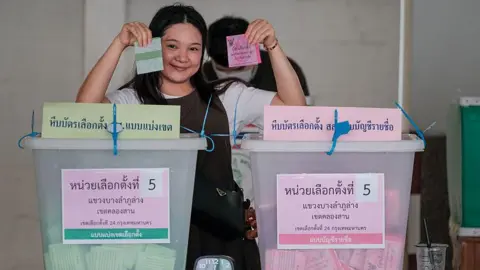
Thailand has voted in an early election called after multiple coalition governments collapsed, leading to three prime ministers in as many years. The election pits reformists advocating for significant change against conservatives led by incumbent Prime Minister Anutin Charnavirakul.
Just like in 2023, the People's Party represents those pushing for far-reaching reform, whereas Anutin's conservative Bhumjaithai party seeks to maintain traditional values and power structures.
The youth-led reform movement won the last election, but faced severe obstacles, as a military-appointed senate prevented them from forming a government, and their party was later dissolved by constitutional courts. Powerful unelected forces have consistently intervened to maintain the status quo in Thailand.
The results of the election will be revealed around 22:00 local time (15:00 GMT), with expectations that no party will secure an outright majority.
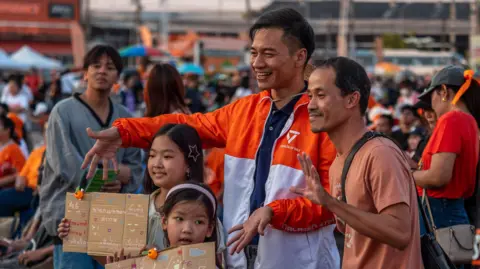
The People's Party, led by Nattaphong Ruengpanyawut, aims to challenge the dominance of large businesses and the military while modernizing the education system. Economic concerns, particularly rising costs and fears of industrial relocation to neighboring countries, have been significant issues highlighted by voters.
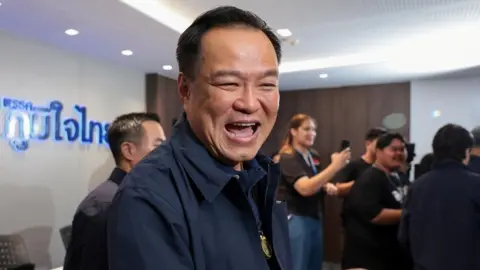
On the other hand, Anutin Charnavirakul’s Bhumjaithai party has capitalized on patriotic sentiment, particularly after recent conflicts along the Thailand-Cambodia border, advocating for the protection of Thailand's traditional institutions.
The third main contender, the Pheu Thai Party, historically dominant due to its populist policies, is expected to lose noticeable support due to accusations of mismanagement in its previous coalition government and the incarceration of its former leader, Thaksin Shinawatra.
This election is not just about choosing a prime minister; it also involves a referendum on reforming the 2017 constitution, which has been criticized for empowering unelected entities that constrain democratic processes. Public sentiment is strong for change, as many voters express discontent with the status quo.
As voters weigh their options between reform and conservatism, the potential for further political instability looms large. The outcomes of this election could steer Thailand’s political future in either a radical or traditional direction, fundamentally shaping the country's governance and its socio-economic landscape.