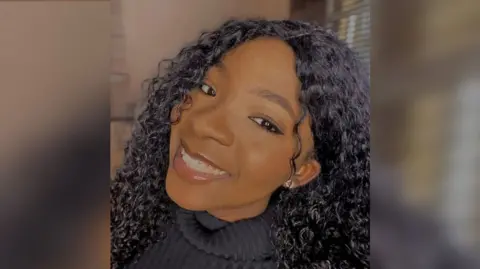
There has been an outpouring of grief in Nigeria following the death of an aspiring singer who died on Saturday after being bitten by a snake in the capital, Abuja.
Ifunanya Nwangene, 26, rose to prominence after appearing on The Voice Nigeria, the local version of the international TV singing competition, in 2021. She was known for her versatility, blending jazz, opera, classical music, and soul.
Videos shared on social media show a snake handler removing a snake from her apartment, as people nearby can be heard screaming: It is a cobra!
A close friend, Sam Ezugwu, the co-founder and music director of the Amemuso Choir where she sang, told the BBC that Nwangene was a rising star. He said she had been planning to stage her first solo concert later this year. She was also a trained architect.
Hillary Obinna, another friend who sang alongside her, told the BBC he was informed that she had been asleep when the snake bite woke her up.
He said that two snakes were later found in the house.
She first sought treatment at a nearby clinic, but they did not have any antivenom, so she went to a hospital.
Ezugwu said he rushed to the hospital after learning that she had been taken there. He said the hospital had one of the required antivenoms but not the other.
While they were trying to stabilise her, she could not speak but she could make hand gestures. She was struggling to breathe, he added.
Ezugwu said he drove out to search for the missing antivenom but returned to find that she had died. The BBC has asked the hospital for comment.
He said the entire choir went to the hospital that evening, hoping that a miracle would happen.
Obinna described Nwangene as a very wonderful girl, humble, very intelligent, and very talented. Everybody is shattered. We could not sleep at night.
Her death comes amid a renewed debate in Nigeria about the quality of healthcare and patient safety, following a series of allegations of medical negligence.
These include the recent death of novelist Chimamanda Ngozi Adichie's 21-month-old son. The hospital in that case has denied any wrongdoing.
In response to the public outcry, Nigeria's health minister has acknowledged systemic challenges in the health system and announced the creation of a national task force on clinical governance and patient safety.
Most snakebite victims in Nigeria are believed to live in rural areas, and many Nigerians are shocked at Nwangene's death in an upmarket part of the capital.
The World Health Organization (WHO) states that venomous snakebites are a neglected public health issue in many tropical and subtropical countries.
In Africa, between 435,000 and 580,000 snakebites requiring treatment are recorded each year, according to the WHO. The burden falls mainly on women, children, and farmers in rural communities, where health systems are weakest and medical resources limited.
Those bites cause about 30,000 deaths annually in sub-Saharan Africa, though some estimates suggest the real number is much higher.
Experts say the shortage of antivenom is a major reason the scale of the problem is hard to assess. It leads many bite victims to seek care from traditional healers, meaning cases often go unrecorded.
Even where antivenom is available, it is often too expensive, and storage is difficult because most antivenoms require refrigeration in areas with unreliable electricity.