BYD Confirms Success Without US Market Amid Growing Global Demands
Chinese electric vehicle (EV) manufacturer BYD has declared its capability to succeed in the global market without relying on the United States, as it experiences an increase in demand in regions such as Europe and Brazil. Stella Li, the executive vice president of BYD, emphasized the company's focus on meeting international customer needs amid fluctuating oil prices, which are driving consumers toward electric vehicles.
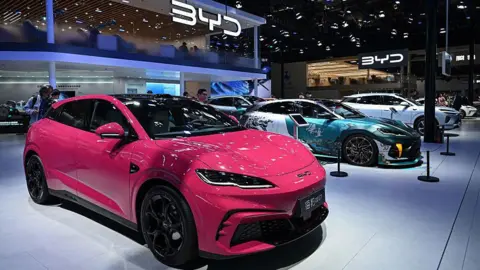
BYD has dramatically expanded its presence globally and, after surpassing Tesla as the largest EV seller last year, is focusing on enhancing production capacity and introducing innovative technologies. At the Beijing Auto Show, Li stated that 'we survive and are successful without the US market today,' indicating a shift in strategy as the company explores international markets.
The rising fuel prices due to geopolitical tensions have ignited interest in EVs as cost-saving alternatives for consumers. Li noted that the demand for BYD's vehicles has grown so substantially that it is currently facing challenges in keeping up with production.
In response to consumer concerns regarding charging times, BYD is investing in its new 'flash charging' technology, which promises to add significant driving range within minutes. This advancement could potentially sway hesitant customers toward considering electric vehicles.
The backdrop of BYD’s growth is complex, involving international scrutiny and tariffs on Chinese goods, particularly in the U.S. However, opportunities in other markets are broadening its customer base, and as Li stated, 'we are not just a car company. We produce one-third of global smartphone components, and we are a leading player in battery storage.'
The recent Beijing Auto Show showcased more than 1,400 vehicles, with Chinese manufacturers, including BYD, taking center stage amid a fiercely competitive environment. Companies like X-Peng introduced innovations, including plans for humanoid robots and flying cars.
Despite current adversities, Li expressed the inevitability of market consolidation, mirroring historical shifts in the automotive industry. 'History suggests not all will survive,' she warned, highlighting the intense competition and rapid development cycles within China's electric vehicle market.