Votes are being counted in Bangladesh after its first election since student-led protests ousted prime minister Sheikh Hasina in 2024.
More than 2,000 candidates are vying for 300 elected seats in parliament, though none from the banned Awami League of Hasina, who fled after 15 years in power following a brutal security crackdown that killed hundreds of protesters.
The election pits the centre-right Bangladesh Nationalist Party (BNP) against a coalition led by the Islamist Jamaat-e-Islami, which joined forces with a party that emerged from the student uprising.
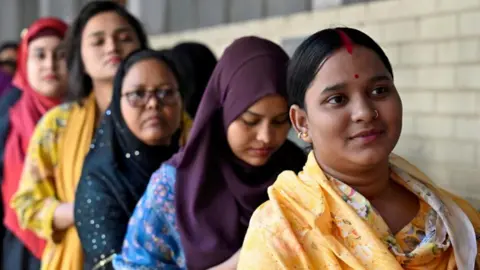
Results are expected on Friday, and there is widespread hope among voters for a return to democracy.
This election marks the first time since 2008 that its outcome cannot be predicted with certainty, as previous elections were condemned as systematically rigged in favor of Sheikh Hasina.
Hasina has been sentenced to death in absentia for ordering a brutal crackdown against protesters, resulting in the deaths of as many as 1,400, according to the UN. She now lives in exile in India, rejecting the charges and questioning the election's legitimacy.
The absence of the Awami League casts doubt over the election's freedom and fairness. However, voters express feeling they have real choices for the first time in years. Over 120 million people are eligible to vote, with a significant portion being under 37. They are also participating in a referendum on proposed constitutional changes aimed at reforming a broken political system.
Interim leader Muhammad Yunus declared a new beginning for the nation post-voting, reporting a turnout of 49% by early afternoon local time. With nearly a million police and soldiers deployed to ensure security, leading candidates from the BNP and Jamaat cast their votes in Dhaka.
Tarique Rahman of the BNP, who has criticized Islamic sentiment in politics, promises economic reforms and a commitment to building a "rainbow nation." Rahman awaits a shift in decades of dynastic politics.
As the question of Jamaat's role rises, its candidates, alongside the BNP's traditionalism, reflect a complex political landscape. While Jamaat has campaigned on justice and anti-corruption grounds, female representation remains notably low, raising concerns among voters who played crucial roles in the uprisings.
As Bangladesh stands at a crossroads, the impact of this election may reverberate through its political climate for years to come.