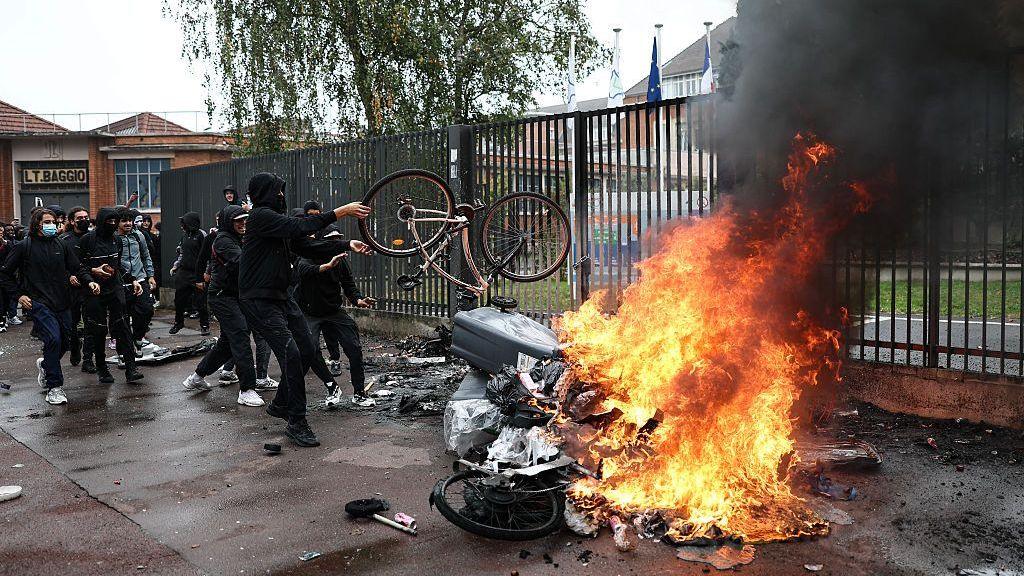
A wave of student blockades that began last week across French secondary schools has turned violent, with fires breaking out at several institutions, most notably in Nantes, Rouen and Marseille.
In Nantes, a bin ignited near the Nelson Mandela high school, the blaze expanding to the entrance hall. Reporters captured the flames rising and students actively setting the fire. In Marseille, a group of protesters poured petrol into a school courtyard, cooking e‑scooters and damaging property, while in Rouen the front of a building was engulfed by flames after a pyrotechnic device detonated.
Students say their grievances extend beyond a single incident: they claim there are too few teachers, classes are overcrowded, school buildings have leaking roofs and toilets are inadequate. University students joined the demonstrations, echoing demands for increased funding and improved conditions for all levels of public schooling.
Prime Minister Sébastien Lecornu convened a crisis meeting on Thursday to confront the unrest. The government and several hard‑right politicians have described the demonstrations as “urban violence”, while left‑wing parties accuse the right of inflaming tensions. Politician Jean‑Luc Mélenchon emphasized the need for non‑violent protest and criticized the politicisation of student petitions.
Police reports indicate that 625 people were arrested on Wednesday, and by Wednesday evening more than 600 arrests were made, excluding Paris. The police force suffered 83 injuries during confrontations. Public transport services in Marseille and Strasbourg were suspended due to vandalism, threats of violence and containment measures.
Allegations have circled that some attacks were planned by organised groups. Hard‑right candidates Marine Le Pen have called for a new anti‑riot law, whereas left‑wing representatives even suggested that violence could be “legitimate” if it arose from state neglect. Across the country, local officials have condemned the violence while urging calm and constructive dialogue.
As France heads into its next general election, the school protests remain a focal point for national debate. Citizens, students and policymakers are watching closely to see how well the government can restore order, address longstanding grievances, and prevent further escalation.