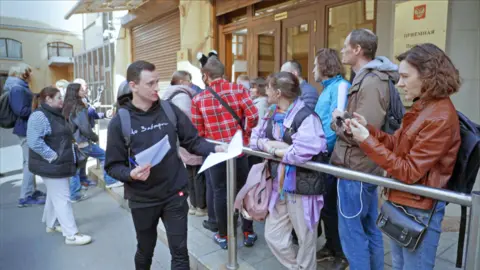
Near the Kremlin, several dozen people queue outside the presidential administration office, holding petitions urging President Vladimir Putin to lift the heavy internet crackdown that has gripped Russia. With increasing restrictions on access to global messaging apps and widespread mobile internet disruptions, public discontent continues to rise.
Petitioning the president may be legally permissible, but in an authoritarian landscape, it comes with significant risks of retaliation. Armed officers film the petitioners, provoking a sense of fear among citizens like Yulia, who shakes at the prospect of being targeted for her dissent.
Putin defends the disruptions as a counter-terrorism necessity but promises essential internet services will remain operational. Nonetheless, many Russians face daily hardships as a result of the controls. Catering business owner Yulia recounts her losses due to site accessibility issues linked to internet censorship and fears that her livelihood may vanish without reliable online access.
Authorities argue that their actions serve public safety interests, while simultaneously targeting virtual private networks (VPNs) and limiting access to popular messaging platforms like WhatsApp and Telegram, claiming violations of Russian data laws. The Kremlin is promoting its state-sponsored messaging application, MAX, yet skepticism abounds regarding its intentions.
Despite such pushbacks, many citizens have grown accustomed to a digital life that hinges on unrestricted internet. As communication gaps widen, frustrations become palpable. Citizens express concerns over their ability to conduct daily business tasks that now heavily rely on stable internet connectivity.
Opposition figures and commentators suggest that the government's efforts to control cyberspace echo broader patterns of isolationism reminiscent of historical pasts, wherein Russia seeks to shield its citizens from perceived 'dangerous' external influences.
As public sentiments evolve, it appears the discontent is building into a significant undercurrent challenging the foundation of Putin's governance, prompting discussions around the future state of freedoms in Russia.