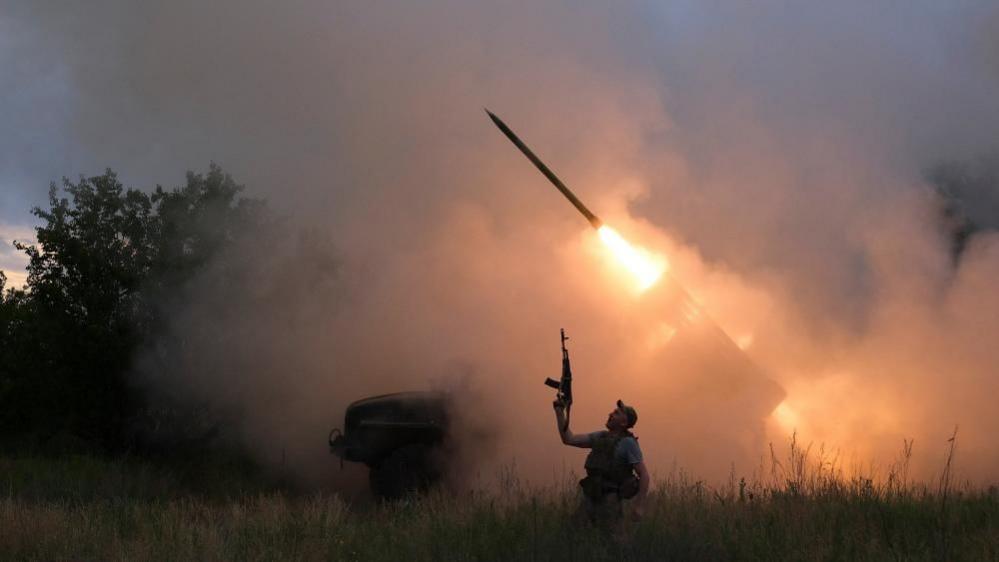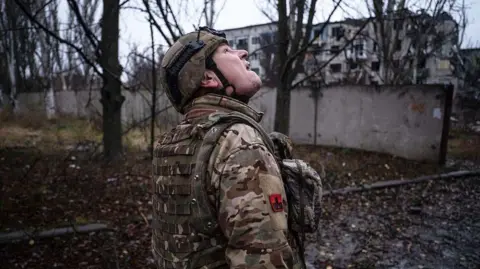
After 225 days stuck in a front-line foxhole, a Ukrainian infantryman known as Kenya could barely walk due to muscle weakness. Despite multiple attempts by his commanders to rotate him out, the threat posed by drones made it nearly impossible to reach him. The region around Kostyantynivka has become one of the most dangerous areas in the conflict, with Russian forces edging closer.
Kenya, after a perilous journey of 11 kilometers (about 7 miles) to return to his brigade, emphasizes that the modern battle is increasingly defined by drone warfare. 'Most fighting was done by drones,' he shares, highlighting the profound shift in tactics where speed has become more critical than armored vehicles.
Ukraine's 93rd brigade is tasked with defending Kostyantynivka, a strategically critical location that, if captured by Russia, could threaten other Ukrainian strongholds. President Vladimir Putin has reiterated the importance of seizing the Donbas region, yet recent reports indicate the Russian advance has slowed.
In the gray zone of the frontline, combat strategies have drastically changed; now small groups of soldiers sometimes ride into battle on bicycles or motorbikes. Kenya describes the harrowing conditions, including worrying about being detected by enemy drones and enduring extreme weather. Supplies are increasingly scarce, with drones being the primary means of delivering food and ammo, often falling short due to technical failures or interceptions.
The fight in this kill-zone is now as much about survival and territory retention as it is about the latest technology. Despite the reliance on drones and robotics for combat, soldiers like Kenya play a critical role in holding positions, illuminating the paradoxes of modern warfare. Without them, frontline stability would likely collapse.
Kenya, after a perilous journey of 11 kilometers (about 7 miles) to return to his brigade, emphasizes that the modern battle is increasingly defined by drone warfare. 'Most fighting was done by drones,' he shares, highlighting the profound shift in tactics where speed has become more critical than armored vehicles.
Ukraine's 93rd brigade is tasked with defending Kostyantynivka, a strategically critical location that, if captured by Russia, could threaten other Ukrainian strongholds. President Vladimir Putin has reiterated the importance of seizing the Donbas region, yet recent reports indicate the Russian advance has slowed.
In the gray zone of the frontline, combat strategies have drastically changed; now small groups of soldiers sometimes ride into battle on bicycles or motorbikes. Kenya describes the harrowing conditions, including worrying about being detected by enemy drones and enduring extreme weather. Supplies are increasingly scarce, with drones being the primary means of delivering food and ammo, often falling short due to technical failures or interceptions.
The fight in this kill-zone is now as much about survival and territory retention as it is about the latest technology. Despite the reliance on drones and robotics for combat, soldiers like Kenya play a critical role in holding positions, illuminating the paradoxes of modern warfare. Without them, frontline stability would likely collapse.