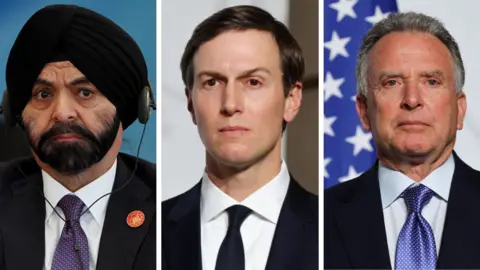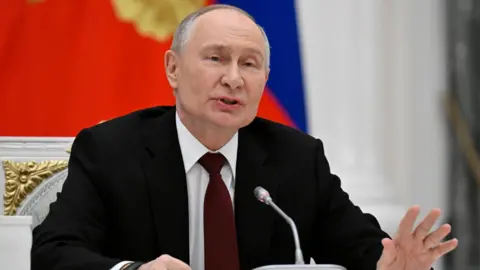
Russian President Vladimir Putin will meet US special envoy Steve Witkoff in Moscow on Tuesday, after the White House expressed optimism regarding a potential peace deal to conclude the ongoing Ukraine conflict. US President Donald Trump's son-in-law Jared Kushner, who has been an adviser in diplomatic discussions, is also expected to attend.
This meeting follows two days of negotiations in Florida between Ukrainian and US officials, including Witkoff and Kushner, aimed at refining a US-backed peace plan perceived to be favorable to Russia. Ukrainian President Volodymyr Zelensky characterized the discussions as 'constructive', but acknowledged the presence of 'some tough issues' that need resolution.
After meeting with French President Emmanuel Macron in Paris, Zelensky highlighted Ukraine's priorities in peace negotiations, emphasizing the need to maintain the nation's sovereignty and secure robust security guarantees. He identified the territorial issue as particularly contentious, with the Kremlin's demand for Ukraine to cede territory in the east remaining a significant sticking point.
Witkoff had also conferred with UK Prime Minister Sir Keir Starmer, Zelensky, and Ukraine's chief negotiator Rustem Umerov, while key European leaders participated in discussions with Zelensky and Macron.
White House Press Secretary Karoline Leavitt expressed optimism about the draft peace deal being 'very much refined', though she deferred specifics to the negotiators involved. In earlier statements, President Putin mentioned a draft peace plan presented by the US, hinting it could serve as a basis for negotiations.
Nevertheless, Kremlin officials recently raised doubts about their acceptance of the proposal after Ukrainian and European allies indicated changes to it. The initial US-Russia peace plan released in November drew criticism for its bias toward Russian demands, and its focus on handling frozen Russian assets and terms for Ukrainian market access in Europe.
Macron emphasized that any formal proposal must involve Ukrainian and European input. He cautioned that the issue of territorial concessions could only be resolved by President Zelensky, underlining the necessity for a collaborative approach.
As the situation evolves, the ongoing talks in Moscow reflect the complex interplay of interests surrounding the cessation of hostilities, underscored by territorial disputes and the quest for mutual security guarantees for Ukraine. Meanwhile, reports of Russian forces allegedly capturing strategic towns in eastern Ukraine have yet to be confirmed, highlighting the tense military backdrop against which these diplomatic efforts are advancing.
This meeting follows two days of negotiations in Florida between Ukrainian and US officials, including Witkoff and Kushner, aimed at refining a US-backed peace plan perceived to be favorable to Russia. Ukrainian President Volodymyr Zelensky characterized the discussions as 'constructive', but acknowledged the presence of 'some tough issues' that need resolution.
After meeting with French President Emmanuel Macron in Paris, Zelensky highlighted Ukraine's priorities in peace negotiations, emphasizing the need to maintain the nation's sovereignty and secure robust security guarantees. He identified the territorial issue as particularly contentious, with the Kremlin's demand for Ukraine to cede territory in the east remaining a significant sticking point.
Witkoff had also conferred with UK Prime Minister Sir Keir Starmer, Zelensky, and Ukraine's chief negotiator Rustem Umerov, while key European leaders participated in discussions with Zelensky and Macron.
White House Press Secretary Karoline Leavitt expressed optimism about the draft peace deal being 'very much refined', though she deferred specifics to the negotiators involved. In earlier statements, President Putin mentioned a draft peace plan presented by the US, hinting it could serve as a basis for negotiations.
Nevertheless, Kremlin officials recently raised doubts about their acceptance of the proposal after Ukrainian and European allies indicated changes to it. The initial US-Russia peace plan released in November drew criticism for its bias toward Russian demands, and its focus on handling frozen Russian assets and terms for Ukrainian market access in Europe.
Macron emphasized that any formal proposal must involve Ukrainian and European input. He cautioned that the issue of territorial concessions could only be resolved by President Zelensky, underlining the necessity for a collaborative approach.
As the situation evolves, the ongoing talks in Moscow reflect the complex interplay of interests surrounding the cessation of hostilities, underscored by territorial disputes and the quest for mutual security guarantees for Ukraine. Meanwhile, reports of Russian forces allegedly capturing strategic towns in eastern Ukraine have yet to be confirmed, highlighting the tense military backdrop against which these diplomatic efforts are advancing.