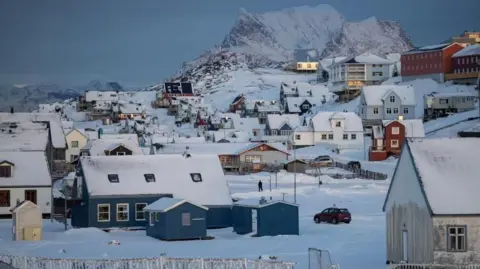
US President Donald Trump has threatened to place tariffs on nations that do not go along with his ambitions to annex Greenland.
Trump said at a White House meeting that he 'may put a tariff on countries if they don't go along with Greenland', which is a self-governing territory controlled by Denmark.
He did not specify which countries could be impacted or the legal rationale behind such a move.
Alongside Denmark and Greenland, other nations have shown opposition, and many in the US have expressed skepticism about the proposed acquisition. As this discussion unfolded, a bipartisan congressional delegation was visiting Greenland to convey support for the territory.
This 11-member group included Republicans who expressed concern about the president's proposals, meeting with members of the Greenlandic and Danish governments.
Group leader Senator Chris Coons stated that the delegation aimed to listen to local opinions and relay them back to Washington 'to lower the temperature'.
Trump has described Greenland as vital for US security, asserting the necessity of American ownership for proper defense against possible threats from Russia and China.
Denmark has cautioned that any military action would jeopardize NATO’s integrity, as the organization operates under the premise that members assist each other against foreign attacks, and never has faced the prospect of a member state using force against another.
European allies have rallied in support of Denmark, asserting that security in the Arctic should be a joint NATO responsibility, with a collective approach to military presence in the region.
Amidst this, Greenland's local leaders have expressed their desire for friendly relations with the US, with representatives calling for more allies and collaborative dialogue.
This contentious issue highlights broader geopolitical tensions in the Arctic and raises questions about future U.S. foreign policy and international relations.