The Democratic Republic of Congo has agreed to accept migrants deported from the US who are not themselves Congolese under a deal effective from this month, officials announced.
The Ministry of Communication reported that a temporary reception system has been established, with facilities identified in the capital, Kinshasa, to accommodate arrivals.
According to the statement, logistical and technical support will be provided by the US, asserting that the Congolese government will incur no financial costs for this initiative.
No specific number of deportees to be accepted by DRC has been disclosed, but it has been noted that the US has been deporting individuals to various African countries as part of its immigration enforcement efforts.
Amidst concerns regarding the potential for migrants to be sent back to countries where they fear persecution, Congolese officials emphasized that these transfers are not planned.
This decision to receive those categorized as third-country migrants—individuals who originate neither from the sending nor the hosting country—reflects DRC's commitment to human dignity and international solidarity, as noted in the governmental statement.
The Congolese authorities have clarified that this strategy is not akin to a permanent relocation mechanism or outsourcing of migration policies.
The BBC has contacted officials at the US State Department and Department of Homeland Security for further comments but has yet to receive a response.
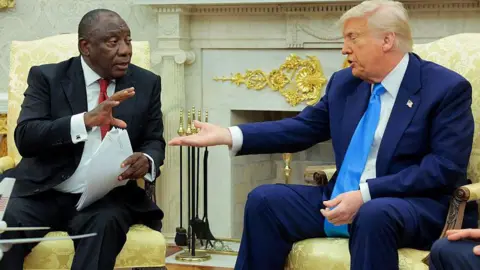
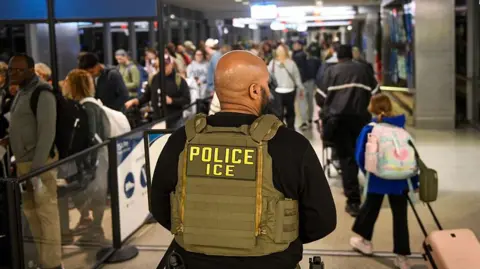
Under President Donald Trump's administration, the US has actively deported dozens of individuals to third countries as part of a stringent immigration enforcement policy. This has drawn criticism from human rights campaigners, who have raised legal concerns about such practices.
DR Congo is joining other nations on the continent, including Eswatini, Ghana, and South Sudan, in accepting deportees from the US. Just last week, eight individuals from various African nations were sent back to Uganda.
It's important to note that a report from the US Senate's foreign relations committee indicated that the Trump administration has likely spent over $40 million on third-country deportations as of January 2026, yet the total costs remain undetermined.
Additionally, the US has provided significant funding, reportedly over $32 million, directly to five countries comprising Equatorial Guinea, Rwanda, El Salvador, Eswatini, and Palau.
The US is also pursuing a minerals deal with DRC, potentially granting access to the nation's extensive reserves of essential elements such as cobalt, tantalum, lithium, and copper.
Furthermore, the US has been a facilitator in peace negotiations between DRC and Rwanda, even though implementing those agreements continues to face hurdles.