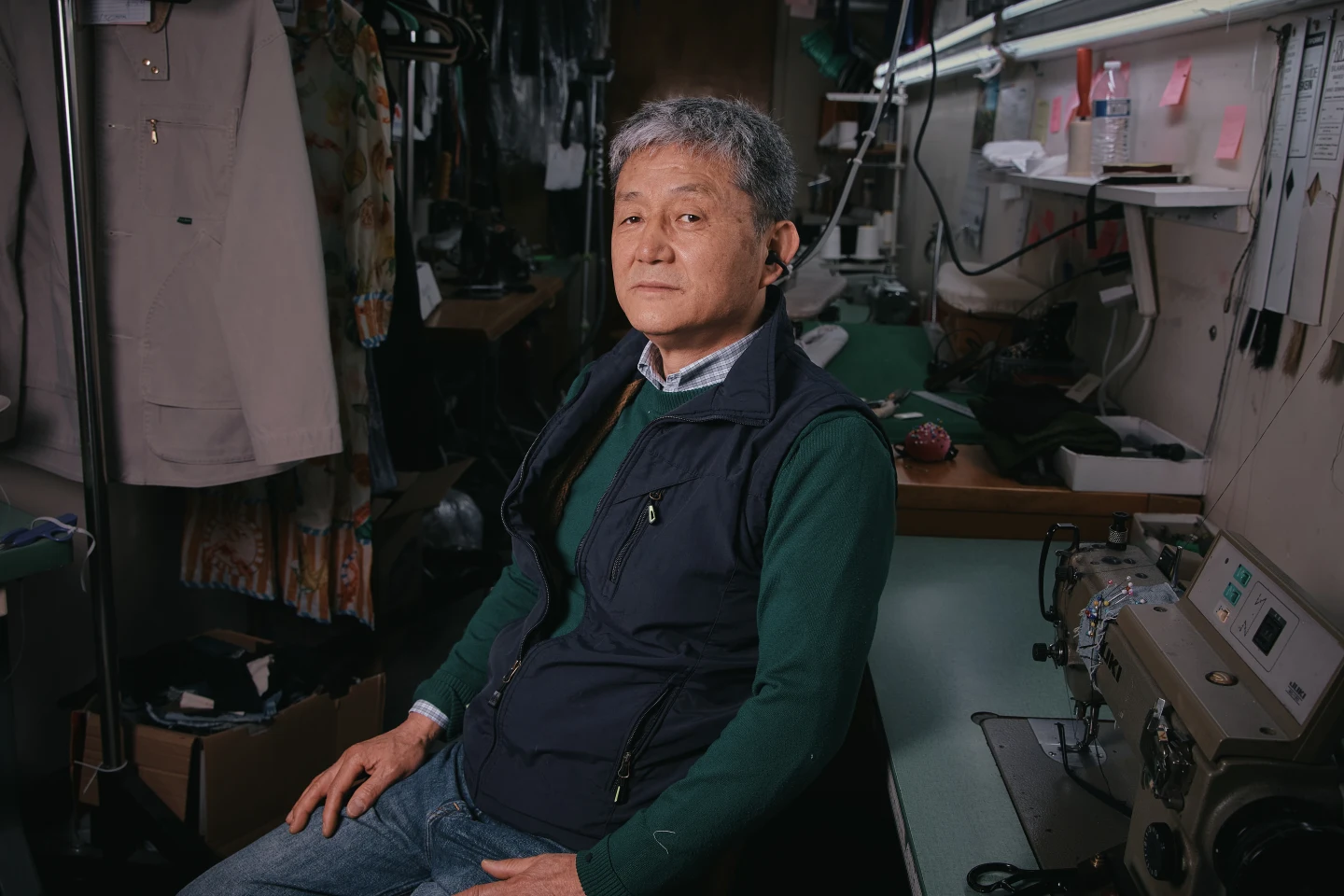
NEW YORK (AP) — Hunched over a sewing machine, Kil Bae is hemming a dress inside his Manhattan tailor shop when a new customer stops by with a vintage Tommy Hilfiger jacket he wants taken in. The modeling agent paid $20 at a thrift store for his reversible bomber style that’s plaid on one side and red on the other. He’s willing to spend $280 to have it slimmed down. Alteration requests with such a price disparity would have seemed odd a few years ago, the tailor says, but are helping to keep the bobbins bobbing at his one-man shop, 85 Custom Tailor.
Bae carefully examines the cotton jacket before moving in to pin it, circling the customer like a sculptor with a chisel. He started training as a tailor at age 17, in his native South Korea. Now 63, he’s part of a shrinking breed in the U.S., where professional sewers, dressmakers and tailors are aging out of the workforce as their services find fresh demand.
Shoppers who grew up on disposable fast fashion are enlisting tailors and seamstresses to give off-the-rack purchases a custom fit or personal flair, to revive secondhand finds, or to extend the lives of their wardrobes, according to fashion industry experts. Weight-loss drugs like Zepbound and Wegovy mean more Americans are seeking adjusted waistbands, tapered sleeves and other types of resizing, Bae said.
“I recommend this job to young people because this one cannot be AI’d,” Bae said, noting that while artificial intelligence is automating pattern making, it cannot replicate a tailor’s handiwork. “Different bodies. Different shape. They cannot copy like this. If I close this door, I can go out and find another one.”
But like engraving, repairing musical instruments, and many other skilled trades, creating and fitting garments to individual specifications hasn’t attracted enough entry-level workers over the years to replace the professionals retiring their pincushions after decades of performing their craft.
The U.S. Bureau of Labor Statistics estimated almost two years ago there were fewer than 17,000 tailors, custom sewers and dressmakers working in business establishments nationwide, a 30% decline from a decade earlier. Including self-employed individuals and people working in private households, the median age for all sewers, dressmakers and tailors was 54 last year, 12 years older than the median for the entire employed population.
The income that proficiency with needle and thread commands relative to the skills needed and the physical toll of bending over detailed work likely discourages teenagers and young adults from heeding Bae’s advice. The mean annual wage for tailors, dressmakers and custom sewers was $44,050 a year, compared to $68,000 for all workers, according to BLS calculations.
“Most of fashion training is really aimed at mass production, not spending time in a shop handmaking a garment,” said Scott Carnz, the provost of LIM College, a for-profit college offering degrees in various disciplines.
Despite the challenges, online job postings for tailors, dressmakers and sewers have remained fairly stable, with a slight decrease reported between February 2020 and February 2023. There is a craftsmanship that plays an important role in the labor market, Stahle added.
Immigrants, both with and without legal status, have powered America’s garment industry for well over a century. Recent census data shows about 40% of tailors and dressmakers are foreign-born, with significant numbers from Mexico, South Korea, Vietnam, and China.
To address a labor shortage, the fashion industry aims to create a new generation of master tailors, with Nordstrom partnering with New York’s Fashion Institute of Technology to launch a program in advanced sewing techniques. The inaugural cohort of students received significant interest.
Back at 85 Custom Tailor, Bae asked often if the customer with the Tommy Hilfiger jacket was sure about the alterations. “I think I fell victim to buying cheap stuff, and then you realize it just falls apart or shrinks,” said the customer. Bae, whose son chose a different path, emphasizes the art of tailoring and continues to hone his skills, aiming to keep this craft alive as long as his hands allow.
Bae carefully examines the cotton jacket before moving in to pin it, circling the customer like a sculptor with a chisel. He started training as a tailor at age 17, in his native South Korea. Now 63, he’s part of a shrinking breed in the U.S., where professional sewers, dressmakers and tailors are aging out of the workforce as their services find fresh demand.
Shoppers who grew up on disposable fast fashion are enlisting tailors and seamstresses to give off-the-rack purchases a custom fit or personal flair, to revive secondhand finds, or to extend the lives of their wardrobes, according to fashion industry experts. Weight-loss drugs like Zepbound and Wegovy mean more Americans are seeking adjusted waistbands, tapered sleeves and other types of resizing, Bae said.
“I recommend this job to young people because this one cannot be AI’d,” Bae said, noting that while artificial intelligence is automating pattern making, it cannot replicate a tailor’s handiwork. “Different bodies. Different shape. They cannot copy like this. If I close this door, I can go out and find another one.”
But like engraving, repairing musical instruments, and many other skilled trades, creating and fitting garments to individual specifications hasn’t attracted enough entry-level workers over the years to replace the professionals retiring their pincushions after decades of performing their craft.
The U.S. Bureau of Labor Statistics estimated almost two years ago there were fewer than 17,000 tailors, custom sewers and dressmakers working in business establishments nationwide, a 30% decline from a decade earlier. Including self-employed individuals and people working in private households, the median age for all sewers, dressmakers and tailors was 54 last year, 12 years older than the median for the entire employed population.
The income that proficiency with needle and thread commands relative to the skills needed and the physical toll of bending over detailed work likely discourages teenagers and young adults from heeding Bae’s advice. The mean annual wage for tailors, dressmakers and custom sewers was $44,050 a year, compared to $68,000 for all workers, according to BLS calculations.
“Most of fashion training is really aimed at mass production, not spending time in a shop handmaking a garment,” said Scott Carnz, the provost of LIM College, a for-profit college offering degrees in various disciplines.
Despite the challenges, online job postings for tailors, dressmakers and sewers have remained fairly stable, with a slight decrease reported between February 2020 and February 2023. There is a craftsmanship that plays an important role in the labor market, Stahle added.
Immigrants, both with and without legal status, have powered America’s garment industry for well over a century. Recent census data shows about 40% of tailors and dressmakers are foreign-born, with significant numbers from Mexico, South Korea, Vietnam, and China.
To address a labor shortage, the fashion industry aims to create a new generation of master tailors, with Nordstrom partnering with New York’s Fashion Institute of Technology to launch a program in advanced sewing techniques. The inaugural cohort of students received significant interest.
Back at 85 Custom Tailor, Bae asked often if the customer with the Tommy Hilfiger jacket was sure about the alterations. “I think I fell victim to buying cheap stuff, and then you realize it just falls apart or shrinks,” said the customer. Bae, whose son chose a different path, emphasizes the art of tailoring and continues to hone his skills, aiming to keep this craft alive as long as his hands allow.