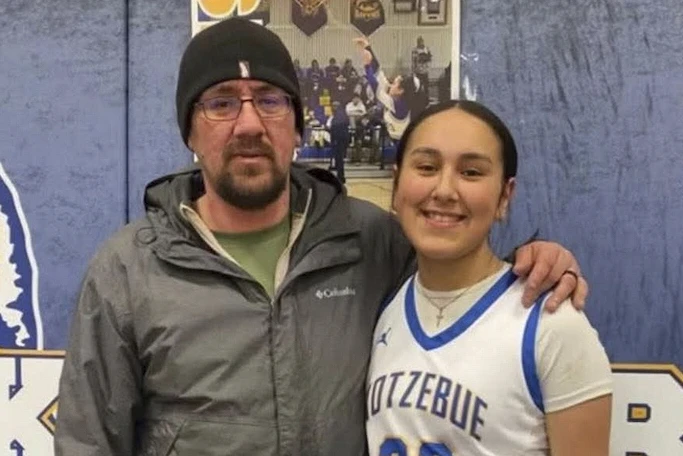
Elmer Brown was following two friends on his four-wheeler last November, hunting caribou across a frozen channel in northern Alaska when the ice gave way. All three plunged into the frigid water. One friend drowned, and Brown, 45, later died of hypothermia, leaving behind five children.
“He was always helping other people and sharing his catch with the elders,” said his brother Jimmy Brown. “It’s been tough, not seeing him. I keep expecting him to walk in and tell me about his day.”
The friends had ventured onto the ice to hunt caribou, under pressure to make the most of shorter and less reliable hunting seasons, Jimmy Brown said.
It wasn’t the first time the family had lost someone to the ice. The Brown brothers’ father drowned in 1999 while seal hunting.
They’re among thousands who have died on ice across the Northern Hemisphere in recent decades as warming winters make conditions thinner and less predictable for those who fish, hunt and recreate on frozen lakes, rivers and coastal waters. March and April are particularly dangerous months as winter conditions recede.
The risks are especially acute in Alaska, where the unpredictable ice season disrupts traditional hunting practices for Indigenous communities and pushes people to take chances. Though some communities are using satellite imagery to assess conditions and social media to share ice observations, technology can’t replace the predictability that generations once relied upon.
Transition seasons are deadliest
A 2020 study examined more than 4,000 winter drownings across 10 countries, including Canada, the U.S., Russia and Japan, over a 26-year period ending in 2017. It found drowning rates surged fivefold when winter temperatures rose to just below freezing. Deaths peaked in March and April, when reduced snow cover allows sunlight to penetrate the ice, melting it from within in invisible ways.
“It’s only a matter of three to five days where you can go from safe ice conditions to totally unsafe,” said Sapna Sharma, a biology professor at York University and the study’s author.
A 2013 study published in the Journal of Public Health found in Alaska alone, some 450 people fell through the ice between 1990 and 2010, with at least 112 deaths. Most accidents occurred in November and March — transition months when ice is forming or melting — while people were traveling or hunting. Snowmobiles were involved in half the cases.
“Our native food is really key in terms of how we survive the Arctic,” Schaeffer said. “The ice is changing too much, and it’s not going to slow down.”
The climate-driven changes are creating difficult choices. Families once reliably hunted caribou by boat during their August to September migration, stocking freezers before winter. Now, herds often arrive in October or November, just as the ice begins its stuttering formation.
“Every day that people can’t go hunting or fishing is one more day of the year where the community is more food insecure, because a whole day of opportunity is lost,” said Alex Whiting, environmental program director for the Native Village of Kotzebue.
In the past, he said, when families could reliably hunt a half-dozen caribou in the fall, they could afford to wait until the ice was solid before heading out again. But with freezers empty and winter setting in, people are more willing to risk traveling on thin ice.
Mike Whiting was one of those people. He experienced falling through the ice while hunting, a scrappy reminder of the pressures and unpredictability that dictate survival in their world.
Globally, lakes are losing some 17 days of ice cover per century, at a rate that has accelerated sixfold over the past 25 years, research shows. The risk of drowning will eventually decline — not because conditions improve, but because ice will largely disappear.
“If we continue releasing greenhouse gas emissions at current rates, by the end of the century, thousands of lakes will no longer freeze and people won’t fall through the ice,” she said.
Back in Kotzebue, Jimmy Brown is still adjusting to life without his brother. They used to ride out into the tundra and gather firewood together, but Brown hasn’t been able to bring himself to do those things alone. He’s been attending Elmer’s daughter’s high school basketball games, trying to support her through her senior year.
“I know I can’t replace her dad,” he said. “I’m just thankful I can be there for her.”