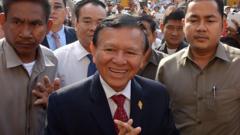
In a surprising political gesture, Cambodia’s acting head of state, Hun Sen, signed a royal pardon that frees former opposition leader Kem Sokha from a 27‑year treason conviction—a sentence that many analysts and civil‑rights advocates described as politically charged.
Sokha, the former head of the now‑dissolved Cambodian National Rescue Party (CNRP), was first taken into custody in 2017 in the days leading up to a critical parliamentary election. The charges were linked to a video in which he claimed support from U.S. pro‑democracy groups. A 2023 conviction demonstrated broad criticism from human‑rights bodies, including those that see the case as a “fabricated conspiracy.”
Hun Sen posted the decree on Facebook, attaching a photograph of the signed royal command, and noted that the pardon served as another step toward bolstering national unity. His son, Hun Manet—who took over as prime minister after his father’s resignation—also praised the move.
While the pardon ends Sokha’s arbitrary detention, it falls short of lifting the five‑year travel ban that remains in place, and his political fiends are still barred from re‑entering the spotlight. Human Rights Watch’s Asia director Elaine Pearson remarked that the decision partially redresses an injustice but that the continued restrictions erode political rights in Cambodia.
Sokha’s story illustrates the broader pattern of pressure on opposition forces in Cambodia: the banning of his CNRP, the closure of independent media outlets, and the lifting of political prisoners only after significant external pressure. The political climate remains unclear, as the country continues to be viewed by many as operating as a de‑facto one‑party state.
The pardon, though a symbolic turning point, leaves open questions about the permanence of democratic freedoms in Cambodia and whether future political competition can truly flourish in the current environment.
Sokha, the former head of the now‑dissolved Cambodian National Rescue Party (CNRP), was first taken into custody in 2017 in the days leading up to a critical parliamentary election. The charges were linked to a video in which he claimed support from U.S. pro‑democracy groups. A 2023 conviction demonstrated broad criticism from human‑rights bodies, including those that see the case as a “fabricated conspiracy.”
Hun Sen posted the decree on Facebook, attaching a photograph of the signed royal command, and noted that the pardon served as another step toward bolstering national unity. His son, Hun Manet—who took over as prime minister after his father’s resignation—also praised the move.
While the pardon ends Sokha’s arbitrary detention, it falls short of lifting the five‑year travel ban that remains in place, and his political fiends are still barred from re‑entering the spotlight. Human Rights Watch’s Asia director Elaine Pearson remarked that the decision partially redresses an injustice but that the continued restrictions erode political rights in Cambodia.
Sokha’s story illustrates the broader pattern of pressure on opposition forces in Cambodia: the banning of his CNRP, the closure of independent media outlets, and the lifting of political prisoners only after significant external pressure. The political climate remains unclear, as the country continues to be viewed by many as operating as a de‑facto one‑party state.
The pardon, though a symbolic turning point, leaves open questions about the permanence of democratic freedoms in Cambodia and whether future political competition can truly flourish in the current environment.