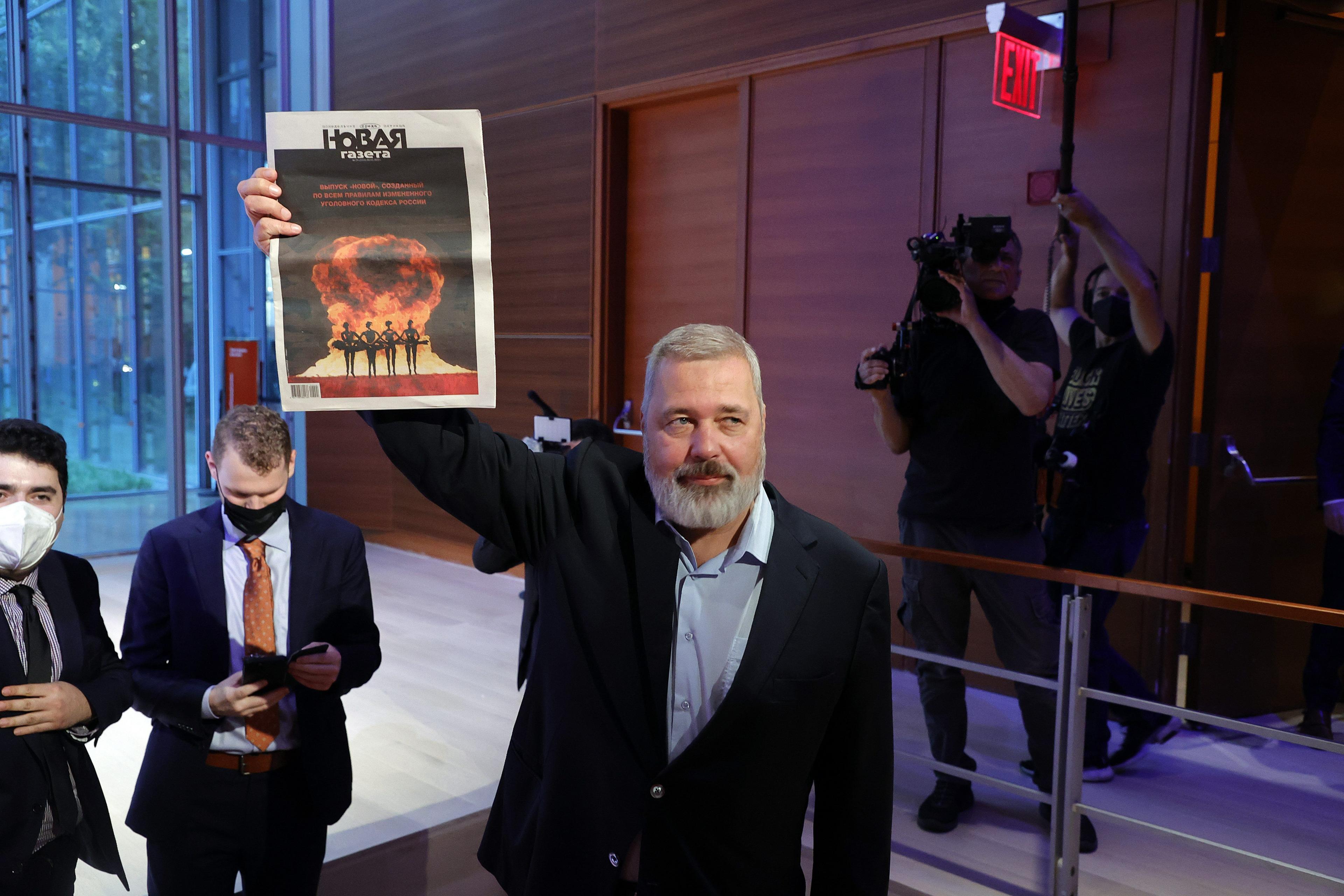
At the quiet Moscow offices of Novaya Gazeta, former chief editor Dmitry Muratov tells the BBC that Russia’s war in Ukraine can never be called a victory. “There will never be ‘victory’, because what has been going on for nearly five years can no longer be considered a victory,” he says.
Muratov, 64, co‑founded the newspaper over three decades ago, and it became the flagship of hard‑hit independent journalism in Russia, exposing abuses and corruption. In 2021 he was awarded the Nobel Peace Prize for his work safeguarding freedom of expression. The Nobel Committee highlighted the danger faced by seven of the paper’s journalists, most recently Anna Politkovskaya, who were killed for reporting on war crimes.
Despite this recognition, Novaya Gazeta’s print operations were shut down after the Kremlin issued a decree that nationalised the paper and revoked its registration. The website remains blocked inside Russia; access is only possible from abroad or through virtual private networks.
Muratov describes how the crackdown on free speech accelerated after Russia’s full‑scale invasion of Ukraine in 2022. He cites the designation of many opinion leaders as “foreign agents”, “extremists” or “terrorists” – a declaration that stalls their civil and professional rights. He estimates that at least 1,500 people have been imprisoned for speaking out since the start of the war, a figure three times higher than during the KGB era.
The article also recounts the courtroom plight of journalists Antonina Favorskaya, Konstantin Gabov, Sergey Karelin and Artyom Kriger, jailed on extremism charges, and the case of pediatrician Nadezhda Buyanova, sentenced to five and a half years for criticizing the war. Muratov shows photographs of arrested journalists and a pianist, Pavel Kushnir, who died in a detention centre during a hunger strike.
Muratov, who has been labeled a “foreign agent” himself, explains that the label is meant to stigmatise dissenters and curtail their rights. He reveals that he sold his Nobel Peace Prize medal to finance UNICEF’s humanitarian efforts for Ukrainian refugees.
He says, “I see these cases not only as personal suffering but as evidence of the danger any critic faces in Russia.” Yet he notes that silence is the price of security, and that on the streets of Moscow he still hears whispers of gratitude for his work.
Against this backdrop, Muratov’s statement that Putin can no longer claim victory in Ukraine challenges the narrative that Russia’s campaign is still proceeding successfully. It offers a stark reminder of the human cost of the conflict and the extreme costs for those who dare to speak out. For the world, Muratov’s testimony underscores that the war may be a war, but it is not winning any meaningful victory.”