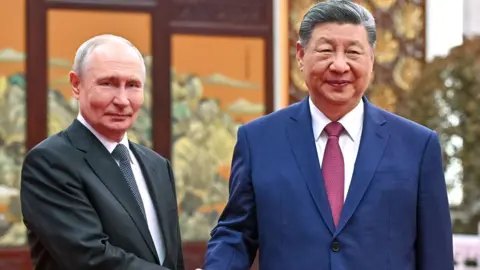
The Great Hall of the People in Beijing reverberated with Russian music as Vladimir Putin and Xi Jinping exchanged warm greetings during their summit. A military band performed 'Moscow Nights,' a piece with lyrics invoking deep affection for the Russian capital, while the two leaders called each other 'dear friend' and 'old friend.' This display of camaraderie, part of more than 40 formal meetings since 2013, reinforced their public portrayal as strategic partners. Xi's government newspaper even contrasted Putin's reception with Donald Trump's recent China visit, featuring a side-by-side image of the Russian leader and his Chinese counterpart against a photo of Trump alone at the end of his trip.
Yet beneath the diplomatic flourish, the summit revealed the pragmatic limitations of this relationship. Russia had hoped for finalization of the Power of Siberia 2 pipeline, designed to transport additional Russian gas to Northern China via Mongolia—a critical move to offset energy losses after EU sanctions. While both nations signed a memorandum of understanding last year, Beijing's hesitation on finalizing terms—driven by pricing concerns and strategic caution about over-reliance on Russian fossil fuels—left Moscow disappointed but unsurprised.
From multiple perspectives:
- **Russian viewpoint**: As stated in the Kremlin's official newspaper, 'The positions of Russia and China are not identical. Their interests do not always coincide.' Yet Russia views China as essential for economic survival, with President Putin's foreign policy aide explicitly declaring 'the spirit of Beijing exists,' while noting the vanished 'spirit of Anchorage'—a reference to hopes for improved U.S.-Russia relations. For Moscow, diversifying energy markets is paramount amid Western sanctions.
- **Chinese perspective**: Analysts in Beijing emphasize energy security as the core concern. The state media's acknowledgment of non-identical interests reflects Beijing's calculus: avoiding over-dependence on Russian gas to prevent vulnerability to geopolitical shocks. China's cautious approach is seen as part of broader strategy to maintain economic stability while pursuing strategic autonomy.
- **Western analysis**: International observers note the relationship's geopolitical significance for reshaping global power structures. The partnership demonstrates the rise of multipolarity, yet warnings persist about the fragility of these economic ties. The pipeline delay underscores how strategic alliances often require compromise on concrete deliverables despite strong political rhetoric.
The meeting ultimately reinforced the symbolic depth of Russia-China relations while exposing the economic realities that govern their collaboration. As both leaders return to their respective capitals, the question remains whether this alliance—built on shared opposition to U.S. policies and mutual distrust of Western influence—can navigate the complex terrain between idealized partnership and pragmatic economic negotiation.}
Yet beneath the diplomatic flourish, the summit revealed the pragmatic limitations of this relationship. Russia had hoped for finalization of the Power of Siberia 2 pipeline, designed to transport additional Russian gas to Northern China via Mongolia—a critical move to offset energy losses after EU sanctions. While both nations signed a memorandum of understanding last year, Beijing's hesitation on finalizing terms—driven by pricing concerns and strategic caution about over-reliance on Russian fossil fuels—left Moscow disappointed but unsurprised.
From multiple perspectives:
- **Russian viewpoint**: As stated in the Kremlin's official newspaper, 'The positions of Russia and China are not identical. Their interests do not always coincide.' Yet Russia views China as essential for economic survival, with President Putin's foreign policy aide explicitly declaring 'the spirit of Beijing exists,' while noting the vanished 'spirit of Anchorage'—a reference to hopes for improved U.S.-Russia relations. For Moscow, diversifying energy markets is paramount amid Western sanctions.
- **Chinese perspective**: Analysts in Beijing emphasize energy security as the core concern. The state media's acknowledgment of non-identical interests reflects Beijing's calculus: avoiding over-dependence on Russian gas to prevent vulnerability to geopolitical shocks. China's cautious approach is seen as part of broader strategy to maintain economic stability while pursuing strategic autonomy.
- **Western analysis**: International observers note the relationship's geopolitical significance for reshaping global power structures. The partnership demonstrates the rise of multipolarity, yet warnings persist about the fragility of these economic ties. The pipeline delay underscores how strategic alliances often require compromise on concrete deliverables despite strong political rhetoric.
The meeting ultimately reinforced the symbolic depth of Russia-China relations while exposing the economic realities that govern their collaboration. As both leaders return to their respective capitals, the question remains whether this alliance—built on shared opposition to U.S. policies and mutual distrust of Western influence—can navigate the complex terrain between idealized partnership and pragmatic economic negotiation.}