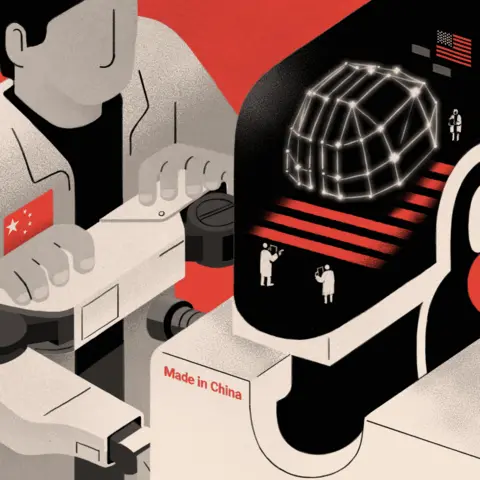
In the second half of the 20th Century, it was the race to develop nuclear arms that occupied some of the finest minds in the US and the Soviet Union. Now, the US finds itself in a different kind of race with a different adversary: China. The aim is to dominate technology; specifically Artificial Intelligence (AI).
It's a fight taking place in research labs, on university campuses, and in the offices of cutting-edge start-ups - watched over by leaders of some of the world's richest companies and at the highest levels of government. It costs trillions of US dollars.
Each side has its strengths, with the US traditionally leading in AI 'brains'—the world of chatbots, microchips, and large language models (LLMs)—while China has been superior in AI 'bodies': robots, particularly humanoid robots that look eerily like humans. However, as both sides strive to prevent their rivals from gaining dominance, the balance of power may shift.
The battle for LLM dominance
The launch of ChatGPT by OpenAI on November 30, 2022, revolutionized the landscape for large language models (LLMs). With claims of over 900 million users weekly, the U.S. has a commanding lead in LLM development, aided by significant investments from firms like Google and Anthropic. The potential for LLMs to revolutionize white-collar work also adds a commercial dimension to the race.
How the Americans played their chips
The strategic advantage for the United States pivots on not just advanced algorithms, but crucially, the hardware enabling immense computational power. Dominance over high-end microchips, largely designed by companies like Nvidia, underpins the U.S. lead in AI. Furthermore, strict export controls ensure that these powerful chips do not reach China, reinforcing that lead.
The DeepSeek counter-attack
In January 2025, China launched its own AI-powered chatbot, DeepSeek, which resonated with similar capabilities to ChatGPT at substantially lower costs. The success of DeepSeek demonstrated China's ability to innovate in AI despite restrictions on high-end chips, highlighting a rapid evolution towards self-reliance in the AI sector.
China's advantage in the robot wars
Historically, China has excelled in the realm of robotics, buoyed by government support and a robust manufacturing sector. With about two million operational robots, China's investment has propelled it to lead globally in humanoid robot technology.
The ghost in the machine
While China leads in building robot bodies, it still relies on U.S.-designed brain software for advanced AI capabilities. The dichotomy between the U.S. and China's approaches represents different philosophies in tech innovation: closed proprietary systems versus a more open-source strategy.
Who will triumph?
The ultimate victor in this technological contest remains uncertain, as sustained advantage rather than a singular victory is paramount. With frameworks evolving for AI integration into economies, who manages to embed these technologies effectively will likely determine long-term dominance.
In conclusion, while the US and China have distinct advantages in the AI race—brains versus bodies—the outcome will shape the geopolitical landscape and technological developments for decades to come.